How to advance the maturity of regenerative agriculture in Australia
Having arrived in Australia one year ago today, it’s been interesting to compare and contrast the maturity of the regenerative food and farming field here with that of Europe and the Americas. Most importantly, it's been an opportunity to reflect on the strategies needed to advance the maturity of the field in Australia, and what can be learned from other geographies.
Using the maturity curve
The 2024 report Financing for Regenerative Agriculture (authored by Transformational Investing in Food Systems / TIFS, Pollination and The Rockefeller Foundation) uses a "market maturity curve" to show that new fields mature in phases. Each phase needs its own strategies and specific forms of capital to move it on to the next.
The curve was originally designed to help institutional investors assess how mature a market is and whether it is ready for investment. Yet the framework can be adapted to understand the maturity of an entire field more widely: how widely an approach has been adopted, and what needs to be in place for it to keep developing and spreading. It can give us a more holistic view of how a field can develop over time.
Using such a framework to understand the current maturity of the field can help identify what's needed right now to move it to the next phase.
During my time working with TIFS on the Regenerative Catalysts programme, Rex Raimond and I would use the maturity curve as a tool for diverse groups in specific contexts – whether they be regions, production systems or regenerative pathways – to tease out collective strategies.
What is the current phase of maturity?
To read the current phase, you can look at a range of factors:
- What is the degree of adoption, and which segments is it concentrated in?
- Are there leading enterprises showing that it works?
- How much finance is flowing, where is it going, and in what form?
- Are market players procuring, and who are they?
- Is an evidence base forming, with data that supports feasibility and viability?
- Are enabling policies in place?
- What are the current narratives and sentiment?
- What is the make-up and strength of the enabling organisations?
Australia is still early
Using this framework, regenerative agriculture is beginning to move beyond proof of concept in Australia. Strong examples exist, but the evidence, recognition and support needed for wider adoption are still developing.
While progress varies within and between countries, Europe, the US and Brazil are further along in several areas:
- Evidence base: Research and practical experience appear to be more widely shared and used overseas. In Australia, knowledge is growing, but it does not yet seem to be reaching all the people who could act on it.
- Frontrunners: Enterprises such as Wildfarmed and Alexandre Family Farm offer visible examples of regenerative businesses reaching broader markets. Australia has leading enterprises too, but their achievements and commercial potential remain less widely recognised.
- Finance: Dedicated funds and investment activity appear more established in these markets. In Australia, options remain limited, and much of the support available is framed around climate-smart practices rather than a broader regenerative transition.
- Markets: Overseas, there are more visible examples of brands and corporate programmes building demand for regenerative products. In Australia, these pathways appear less developed, within a market heavily shaped by two major supermarkets.
- Policy: Some overseas policy initiatives explicitly support soil health and related regenerative outcomes. In Australia, support tends to come indirectly through programmes with other primary objectives.
- Enabling initiatives: Australia has a strong network supporting change on farms. The wider support needed to connect enterprise development, finance, infrastructure and markets still appears to be taking shape.
- Sentiment: In some overseas markets, regenerative agriculture has gained enough attention to attract both scrutiny and concerns about greenwashing. In Australia, my impression is that it is still often viewed as a niche approach, particularly outside farming and food system networks.
These observations suggest that Australia is at an earlier stage in building the conditions for regenerative agriculture to become widely adopted and backed. This matters because each stage needs different strategies and forms of capital to move forward.
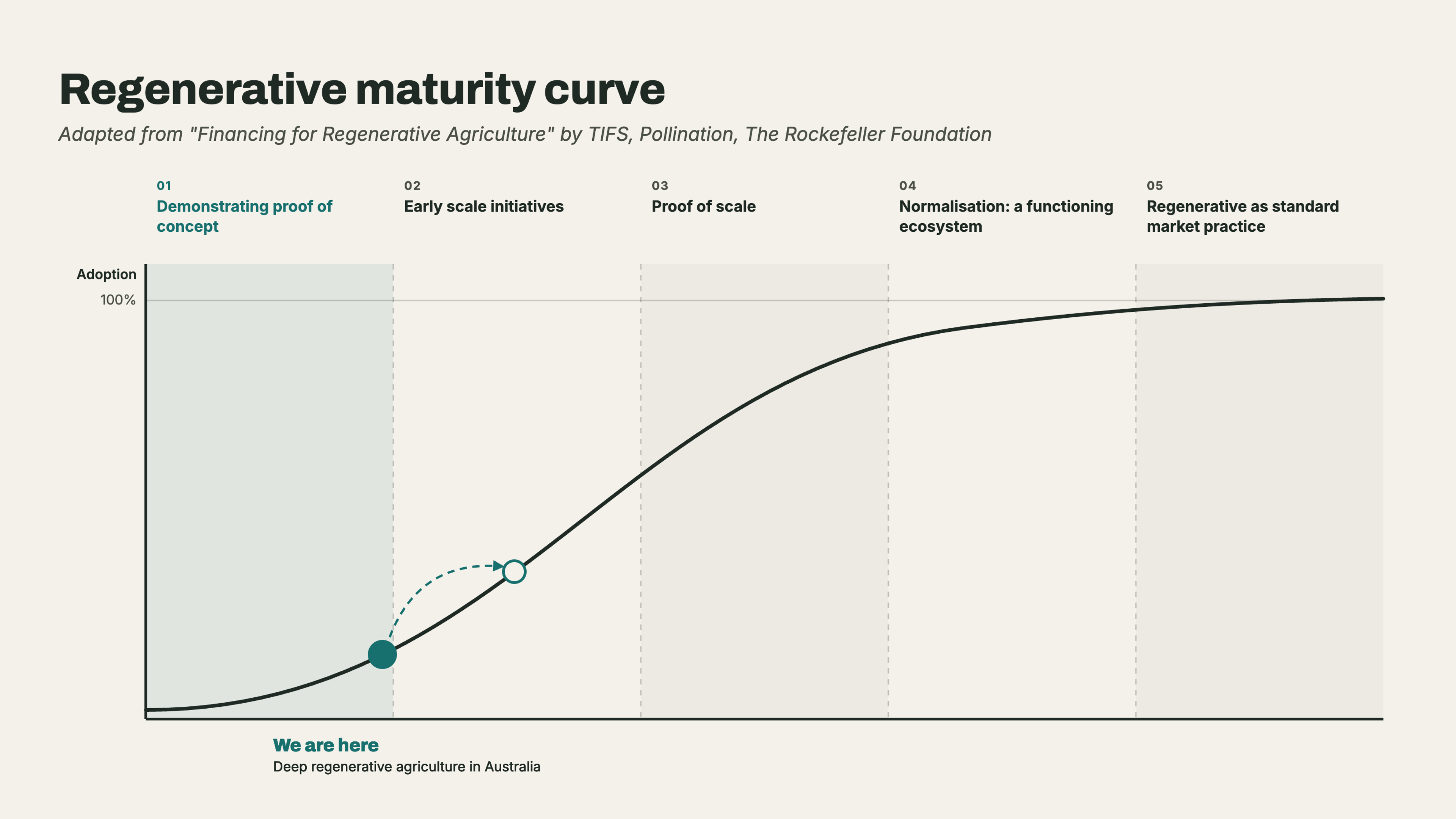
View Maturity Curve for Australia.
Picking the right strategy
Selecting the right strategy for the stage of maturity is critical. A strategy that works for a mature field won’t work in an early one; we need to learn from contexts at a comparable stage.
Solar is often held up as the field regenerative agriculture should learn from. But solar is now far more mature than regenerative agriculture. If its lessons are useful, we'd need to look at the strategy for solar perhaps 20 years ago. In the 1990s and early 2000s, solar was at the proof of concept stage – expensive, niche and mostly used for satellites, remote sites and enthusiasts' roofs. Citizen groups designed guaranteed-price models and governments adopted them, concessional loans got panels onto ordinary homes, early manufacturers scaled up and cut costs, and the narrative shifted from saving the planet to jobs, energy independence and owning your own power. Or we can look at regenerative agriculture in Europe and the US 5 years ago.
Ideally, the strategy coherently brings together all the areas that matter: policy,markets, technology, the evidence base, the network of enabling organisations, finance and so on.
Timing is everything. It’s tempting to be ambitious and shoot for something big, but if the system isn’t ready, you risk being too early. It takes discipline to identify what is needed now and aim to be just one step ahead, not five. There may not yet be enough money, strong enough sentiment, or the enabling infrastructure to support more ambitious plans.
In her book Scaling People, Claire Hughes Johnson states that “leadership is disappointing people at a rate they can absorb.” – leadership here might be “stretching people and the system at a rate they can absorb.”
Shifting from proof of concept
So for Australia, the key is to work out what strategy is needed now to move the field forward, based on what is ambitious enough for what the system can handle.
Different organisations will need to play different roles, which makes thoughtful collaboration especially important. If we can develop a shared understanding of where the field is now, what will help move it into the next stage of maturity, and which organisations are best placed to lead or contribute to each part. The aim is to make sure these efforts work together as a coherent and coordinated approach, rather than happening in isolation.
Demonstrate it works in many contexts: Demonstrate that regenerative agriculture can deliver ecologically, socially and economically, for both singular businesses, communities and wider industry sectors. Importantly, this needs to be across a range of contexts. The leading enterprises and practitioners who are already practicing regenerative, operating solid businesses and creating wider community impacts are the proof points that can make this real.
Shift the sentiment: Use the evidence, strong narratives and stories to change how the field is seen, especially whether it's viable. Economic viability is a common objection, especially to "deeper" regenerative approaches. Proving economic viability is important, as it can typically transcend ideology, which is a common point of friction in the space. There is also certainly a mindset shift required more deeply about humans and nature.
Build a strong ecosystem: Build the strength and longevity of enabling organisations, attract high quality talent to the sector, and selectively collaborate on key strategic initiatives. Do this across key regions and contexts, and make it visible.
Creating the enabling conditions: Secure one or two key policy wins that pilot supportive conditions. Create the first deals with mission-aligned market actors to create values-aligned channels for regenerative products. Build the awareness, knowledge and market infrastructure for mission-aligned capital providers to finance the early deals.
The common refrain of adopting regenerative approaches to agriculture and food is that "regenerative will never feed the world".
At Sustainable Table, we believe regenerative can feed the world – and a redesign of the food system is underway to enable this. There are leading regenerative farms and enterprises who are catalysing this change and demonstrating this possibility, but they are working with a system not designed for them, and thus the odds are against them.
We see a specific role for Sustainable Table in this moment for the development of the sector in three key areas:
- Support leading enterprises to grow their impact and commercial success, creating proof points for the wider sector.
- Mobilise more mission-aligned finance into the field, building on curiosity, interest for values-aligned capital holders to engage in the space.
- Work to shift sentiment – particularly with those who hold the power to change the system – specifically about the viability of regenerative agriculture and its potential to create community wealth and develop rural economies.
Successfully playing this role will be interdependent on the work of others – whether it be our friends at Soils for Life supporting farmers to transition, Food Connect Foundation developing regional food hubs or Open Food Network developing the open data and technology infrastructure needed.
Moving the field forward will take coordinated effort across enterprises, finance, policy and the wider sector. If you're working in this space and see opportunities to collaborate to advance the field, get in touch.
Thanks to Eli Court, Tanya Massy, Dom Walker and Liv McCrimmon for contributing to this article, and TIFS for the original inspiration.