The Chicken and the Egg
The chickens we eat and the chickens that give us eggs are actually completely different. That’s because they have been selectively bred to perform each of these functions. A good layer won’t pack on the weight that a meat chicken needs to and vice versa. Meat chickens are known as broiler chickens and have been bred to grow at unnaturally fast rates, often compromising animal health and welfare at the expense of being ready for slaughter at just 35-47 days old.
We dig into the ins and outs of chicken and egg farming below so you can better understand how you might make more ethical choices.
The Chickens We Eat - Meat or ‘Broiler’ Chickens
Our appetite for chicken…
Australians devour 45kg of chicken per person each year! In 1990 it was under half that, at 22kg. This equates to a staggering 28 chickens each, making Australia the fifth largest consumers of chicken meat per capita in the world.
Free range chicken meat only accounts for 10-15% of chicken produced, with less than 1% of the total production also being organic.
The establishment of Kentucky Fried Chicken in Australia, with its first store opening in 1968, had a major impact on the consumption of chicken. In the 12 months from 1970-1971, a total of 75 stores were opened and during the same period total Australian production increased by 38%.
The rise of chicken consumption has also been in part due to an increase in awareness of the health implications of eating too much red meat. Additionally, due to the factory-like way the industry now operates, slaughtering birds at just 45 days old, you can purchase a whole chook for around $10, making it an affordable option for many Australian families.
Industry Profile
Australia’s chicken industry is largely controlled by a duopoly Baiada (who own Steggles and Lilydale Free Range) and Ingham’s enterprises, which combined have around 70% market share.
Most chicken growers in Australia are contracted to meat processing companies and are known as ‘contract chicken growers’. Approximately 800 growers produce about 80% of Australia’s meat chickens under these contracts. Contract growers own the farm and provide the management, shedding, equipment, labour, bedding and other inputs to rear chickens. The processing company provides (and owns) the chickens and provides feed, medication and technical advice.
Contract growers are paid a growing fee which currently varies from only 60-80 cents per bird, hence the push to get big or get out.
A typical farm may house 100,000 broiler chickens at any one time and produce a total of 550,000 birds a year in several batches. Due to selective breeding, meat chickens today can reach a weight of approximately 2.8 kg in 42 days. Although this is seen as an industry advancement due the streamlining of costs, the health and welfare of the chickens takes a toll. They often struggle to hold their own weight and suffer broken or fractured limbs because of the harsh conditions.
Broiler Chickens – The Facts
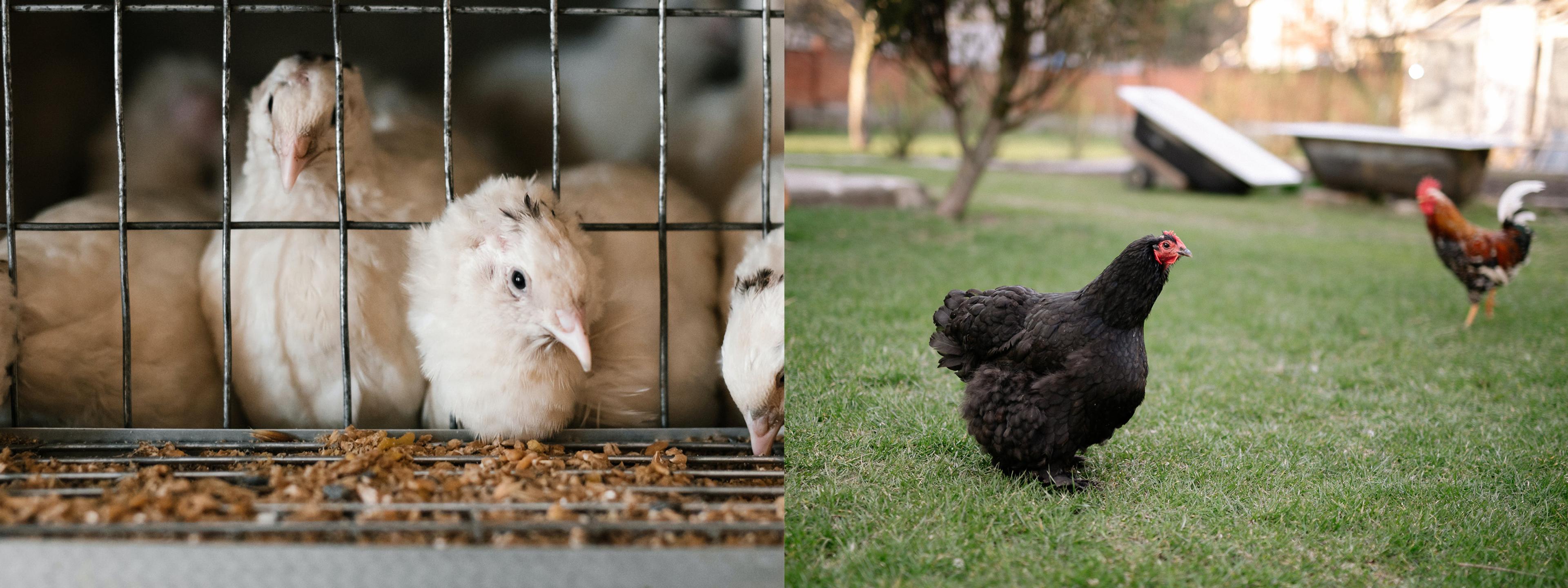
- Every year, there are more than half a billion chickens housed in factory farms in Australia that never get to go outside (see picture above). Even in the RSPCA approved farming system (all Coles branded chicken) birds are housed in sheds for their entire lives. For an RSPCA approved product to have had access to the outdoors it must clearly state free range as well as hold the RSPCA seal of approval.
- It is a myth that hormones are still used to produce chicken, they haven’t been used since the mid 60s. Birds have been bred to grow around three times quicker than what they would naturally, however, this is due to a breeding program, not hormones.
- Meat or broiler chickens grow so unnaturally fast (due to selective breeding) that many are crippled before they are sent to slaughter at just 6 weeks of age (approx. 45 days old).
- Chickens raised for meat are typically kept in sheds that are artificially lit to keep the birds eating as often as possible. The sheds are usually 150 metres long and 15 metres wide and hold about 45,000 chickens at any one time.
What’s the difference?
You can compare the difference between factory farmed, free range and certified organic chicken in the table below.
You will notice below, that although free range and organic chicken must have access to the outdoors, they are still slaughtered when they are just 1-3 months old even though they would naturally live until they were about 7 years old.
Factory Farmed
- Housed in barns
- No access to outdoor forage areas
- Slaughtered at 35-65 days old
- Not given growth hormones
- Can be given antibiotics
- Feed has not been organically grown
- To a limited extent there is use of genetically modified products in feed
Free Range
- Housed in barns
- Access to outdoor forage areas is required once chicks are adequately feathered
- Slaughtered at 35-65 days old
- Not given growth hormones
- Not given antibiotics
- Feed has not been organically grown
- To a limited extent there is use of genetically modified products in feed
Certified Organic
- Housed in barns
- Access to outdoor forage areas is required once chicks are adequately feathered
- Slaughtered at 65-80 days old
- Not given growth hormones
- Not given antibiotics
- Feed must be organically grown
- There is no use of genetically modified products in feed
More About Major Chicken Brands Found at Large Retailers
If you can, always prioritise buying chicken products from smaller pastured and free range farms, the local farmers’ market or your local butcher. But if you don’t have access to these options here is a comparison of common brands found at large retailers.
Intensively/Factory Farmed
- Ingham (other than Marion Bay Free Range brand)
- Red Lea
- Golden Cockerel
- Steggles (Baiada)
- Hazeldene’s
- La Ionica
RSPCA Approved
- All Coles brand chicken
- Freedom Farms
- Hazeldene’s (select products)
- Woolworth’s brand chicken
- Nichols Poultry Chicken
Free Range
- Woolworths Macro
- Lilydale (Baiada)
- Coles Free Range
- Hazeldene’s free range
- Bannockburn
- Mt Barker free range chicken (RSPCA approved as well)
- Marion Bay free range chicken (Ingham’s)
Organic
- Inglewood
- Envirorganic
- Macro Organic
Egg Laying Hens
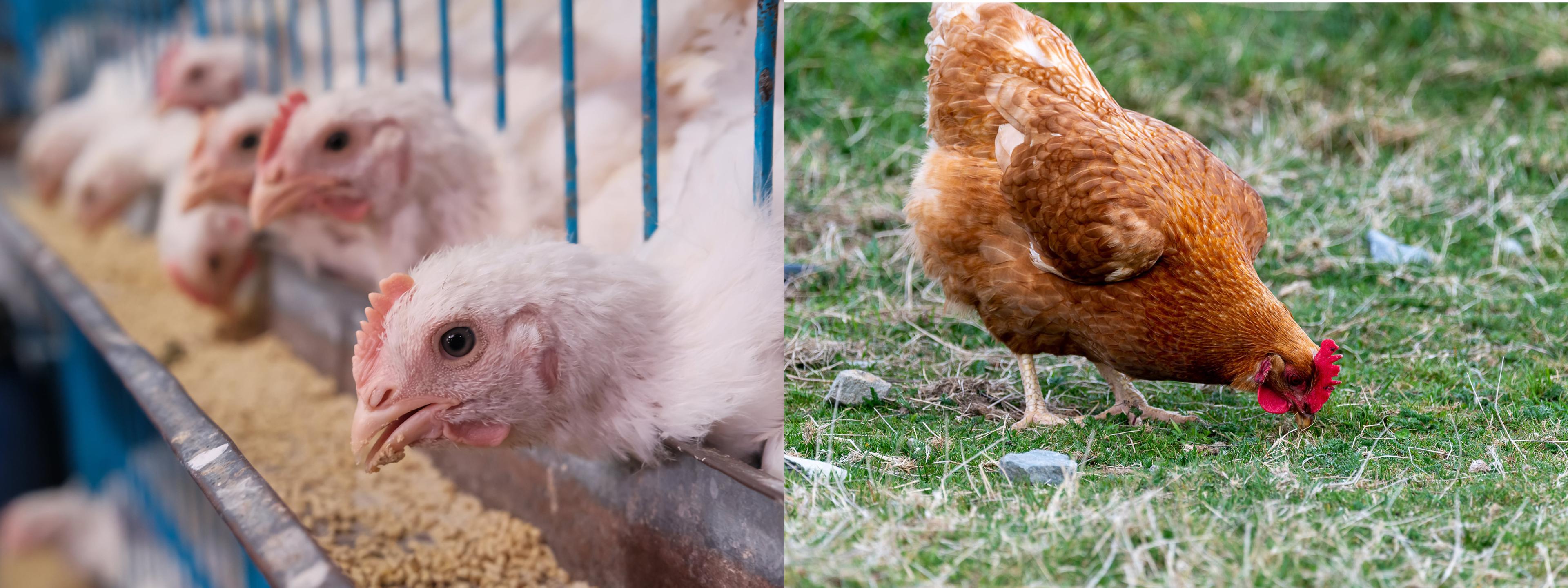
Egg laying hens in battery cages live out their short lives in a space smaller than an A4 piece of paper. While new reforms were announced in 2022 that are set to phase out the use of layer hen cages by 2036 at the latest, there are still millions of hens imprisoned in battery cages at any given time here in Australia.
These hens aren’t protected by the same animal welfare laws as your pets, and thus there is nothing to save them from this cruel treatment.
Have you already made the decision to stop buying cage eggs? The truth is, you may still be doing it unwittingly because eggs act as a filler or added ingredient in many common items.
Here’s a quick list of common items in your grocery basket or on menus that you might forget to ask about:
- Cakes, muffins and sweet goods
- Quiches/frittatas
- Ice-cream (free-range egg ice cream is HARD to find, however there are a lot of egg-free varieties)
- Mayonnaise, hollandaise and dressings
- Schnitzel crumb, stuffings and other batters
- Shop-bought sandwiches, hamburgers
- Pasta
- Egg noodles
- Pastry – pies, tarts etc
Note: Cafes and restaurants may have free-range eggs on their breakfast menu and cage eggs for items that don’t garner the same attention from patrons, so it’s always worth checking.
Layer Hens - The Facts
- 5.36 million layer hens, or 32% of the national flock, were caged in 2020-2021. In egg production alone, 50% of birds are caged.
- Half of all egg laying chickens in Australia are born male (over 12 million per year), they are an unwanted by-product of the egg industry, therefore at 1 day old they are gassed or ground up alive.
- A battery cage houses between 5-7 hens, with each one given less than the size of an A4 sheet of paper to move around in.
- Lack of exercise causes hens’ bones to become weak, brittle and break easily. Studies have shown that 1 in 6 hens inside battery cages live with broken bones.
- Debeaking and beak trimming are common practices used in the industry. A hot iron or laser is used to slice off the beak of the fully conscious chicken without the use of any pain relief.
Give a Cluck - Making Sense of Free Range Eggs
You may have heard the news about free-range egg certification becoming rather lax. If not, we’ll bring you up to speed.
State and federal consumer affairs ministers introduced a legally enforceable national information standard for free-range egg production that came into effect in 2018, which gives farmers clearance to label their eggs ‘free range’ should hens have:
- ‘Meaningful and regular access to an outdoor range’
- An outdoor stocking density of no more than 10,000 birds per hectare (that’s 1 hen per square metre)
This is in stark contrast with the CSIRO guidelines, which recommend that the free range label only be allocated to farmers who run no more than 1,500 hens per hectare (that’s a whopping 8,500 hen difference).
The Problem with the New Free Range Egg Standard
The new free range standard gives credence to misleading free-range egg labels; egg cartons will have to display stocking densities, but there’s no actual requirement for the chickens to go outside.
Higher stocking densities are also more stressful for the chicken. Hens can partake in some pretty nasty and aggressive behaviours such as pecking, bullying and even cannibalism as they fight it out to maintain their hierarchy in cramped conditions, making way for justifications for widespread beak-trimming and de-beaking.
According to the Free Range Farmers Association, 10,000 hens per hectare is not sustainable or responsible farming. They point to the high levels of ammonia in hen manure which can destroy soil health and leach into the ground, leading to poisoning of waterways.
The Good - How to Select Good Eggs
- Raise your own truly free-range chooks and have backyard eggs for you, your family and your neighbours! Check out Milkwood’s free resource on Getting Started with Chickens.
- Buy direct from farmers through local farmers’ markets or at the farm-gate so you can ask questions.
- Look for approved seals and logos and ‘Free Range’ clearly marked on the carton. If dealing with retailers or even when shopping at markets, make sure to read the fine print and look for these seals and logos on the egg carton first and foremost:

More detail on each certification can be found below.
Note on the RSPCA Paw of approval: The RSPCA Paw of approval can also be found on egg cartons where hens do not have access to the outdoors. To ensure your hens get to roam free you would need to see the words ‘Free Range’ and the paw of approval
- 4. Look for a listed stocking density and opt for the CSIRO model code of 1,500 hens per hectare or less. Check out CHOICE’s list of good and bad eggs.
- Choose the free range eggs that were raised closest to where you live. It is good to support local and the food miles are less.
- Don’t forget to check the label or ask if the eggs are free range in common items such as cakes, muffins and sweet goods, quiches/frittatas, ice-cream, mayonnaise, hollandaise and dressings, schnitzel crumb, stuffings and other batters, shop-bought sandwiches, hamburgers, pasta, egg noodles and pastry.
What to Look for When Buying Free Range Eggs
Pastured and free range Egg Directory
It’s important to note that many smaller family farms have not sought certification due to cost or complexity, with their eggs mainly being sold via farmers’ markets or locally through the communities they live in. For a state-based directory of where to find such producers please visit CHOICE.
Certification logos and what they mean
To help with your purchasing decision, especially at large retailers, see the table below which lists various organisations that certify free range egg producers and the standards that they set out.
Australian Certified Organic

Australian Certified Organic logo
- Birds are kept under natural conditions and have access to an open range or suitably fenced managed area
- All birds are permitted access outdoors during daylight
- Maximum of 5 birds per square metre in sheds and birds per shed should not exceed 1500 without consulting the certifier
- Maximum 1000 birds per square hectare in an outdoor paddock
- No beak trimming
- All birds must have access to green pasture
Free Range Farmer's Association Inc.

- Birds are kept under natural conditions, either in an open range or suitably fenced managed areas
- Unrestricted access to outdoors during daylight hours
- Maximum of 7 birds per square metre in sheds and no more than 1000 birds per shed
- Maximum 750 birds per hectare in an outdoor paddock
- No beak trimming
- Birds have access to adequate natural ground cover
Humane Choice

- All birds must have free access to paddocks during the day once fully feathered (around 5-6 weeks old)
- Birds must be allowed free movement and access to paddocks during each day, for a minimum of 8 hours
- Maximum of 5 birds per square metre in sheds and shall not exceed 2500 birds per shed
- Maximum 1500 birds per hectare in an outdoor paddock
- No beak trimming
- Pasture cover should not fall below 40% and consideration must be given to the soil’s health, production capacity, structure and nutrient balance
Pastured Proof

- All birds must have free access to paddocks during the day once fully feathered (around 5-6 weeks old)
- Birds must be allowed free movement and access to paddocks during each day, for a minimum of 8 hours
- Maximum of 8 birds per square metre in a shed and no more than 2500 birds per shed
- Maximum 1500 birds per hectare in an outdoor paddock
- Beak trimming is allowed, however, egg producers must endeavour to purchase point of lay pullets that have not had their beaks trimmed where possible
- Forage must always be available in a sustainably managed rotational grazing system
RSPCA Approved Farming

- Birds must have access to the range for a minimum of 8 hours per day once they are reasonably feathered
- Birds must have easy access to individual openings (popholes), communal popholes or full opening doors
- Maximum of 9 birds per square metre in a shed
- Maximum 1500 birds per square hectare in an outdoor paddock or 2500 if the outdoor range is rotated
- Beak trimming is allowed, upon veterinary advice and only in the first 10 days of life if other measures fail to control cannibalism
- The outdoor range must be well maintained with enough edible vegetation and shade/shelter
- The RSPCA does not require that farms provide hens with access to an outdoor range area to receive the RSPCA paw of approval. Indoor egg farms are guided by a different set of RSPCA standards and can still receive the paw of approval. To ensure your eggs are in fact ‘free range’ you must see the words free range AND the Paw of Approval logo
FREPA

- When fully feathered (around 5-6 weeks old) birds must have easy access to an outdoor range during daylight hours
- Birds must have easy access to an outdoor area during daylight hours
- There can be between 6-10 birds per square metre in a shed, depending on the total number of birds. There can be no more than 4000 birds per shed.
- Maximum 750 birds per square hectare
- Beak trimming is allowed in accordance with the Egg Industry Accreditation Program
- There must be access to pasture with mixed vegetation
Australian Egg Corporation Assured
- Birds are housed in sheds and have access to an outdoor range during daylight hours, once fully feathered (around 5-6 weeks)
- Birds must have access to outdoors during daylight hours through minimum openings of 35cm(h) x 40cm(w). Minimum of 5 openings per 1,000 birds
- Between 11-14 birds per square metre in a shed, no maximum limit per shed (often stacked three high)
- Maximum 10,000 birds per square hectare in an outdoor paddock
- Beak trimming is permitted
- There are no specifications related to pasture cover
The Bad
Now that the definition of free range includes hens raised in unnaturally large stocking densities of 10,000 hens per hectare, it is important to learn about the brands that do not currently stack up. The Model Code indicates that 1,500 hens per hectare is a more acceptable limit.
Check out CHOICE’s list of free range egg providers that do and don’t adhere to the Model Code based on stocking density.
The Ugly
Marketeers have become very creative with terms that aren’t quite free-range, yet sound lovely and confuse consumers. Be cautious of terms such as ‘free to roam’, ‘barn raised’, ‘grain-fed’, ‘corn-fed’, ‘happy hens’, ‘eco-eggs’ – none of these indicate a better life for the animal or a free range environment.
Some brands are also clever at convincing you that their whole egg production is certified organic by using organic grain feed. To ensure that your eggs are both organically farmed and fed look for the certification.
How to avoid GM?
The only ways to be 100% certain that your eggs have come from hens that haven’t been fed a GM diet is by purchasing certified organic eggs (GM is not allowed in organic farming systems) or have a conversation with the farmer.
If you enjoyed reading this article and want to support the work that we are doing, donate today.